 US Market

Stock Activity:
ALL USD Stocks

Chat Now !

Baseball Opens the 2018 Season With All 30 Teams

While everyone is set to play Thursday, MLB is looking to expand its following in the U.K. and Asia.
All 30 Major League Baseball teams will be in action when the season opens Thursday, the first time in 50 years that the organization has had every team play on opening day. It’s also probably the last for a while. MLB plans to open the season in Asia next year and in 2020, which—if past openers in Japan and Australia are any indication—means a staggered start to those seasons, allowing for travel.
But the owners and players have also committed to games in England in June during both seasons, setting up the sport’s most international season ever. (The New York Yankees and Boston Red Sox are near an agreement to play two games at London Stadium next year.) In the trip across the Atlantic, baseball will be following the NFL and NBA. Like those leagues, MLB will find both a deep culture of fandom and broad ambivalence about the game itself.
The NFL staged its first game in London at Wembley Stadium in 2007 and has played at least two games there every year since 2013. The league has also announced a 10-year agreement with Tottenham Hotspur to play games at the Premier League team’s new stadium, which is due to open later this year. The Jacksonville Jaguars, a football fixture at Wembley since 2013, have signed on to play there once a year until at least 2020.
The NBA, for its part, began playing at least one regular season game at the 02 arena in London in 2011 (with a brief interruption caused by a labor dispute in 2012). MLB has yet to play a game in Europe.
In the short term, playing in London creates immediate buzz on both sides of the Atlantic. Both the NFL and the NBA routinely sell out, and London games produce a reliable stream of news coverage. The longer-term impact is harder to detect. According to an annual tracking survey by Nielsen Sports, 12.9 percent of U.K. residents say they’re interested in the NFL; 12.1 percent express interest in the NBA and 7.6 percent in MLB. The tallies show little change in the last three years.
London Calling?
U.K. residents aged 16-to-69 who say they are interested in each of the three biggest U.S. sports leagues.
Nielsen Sports
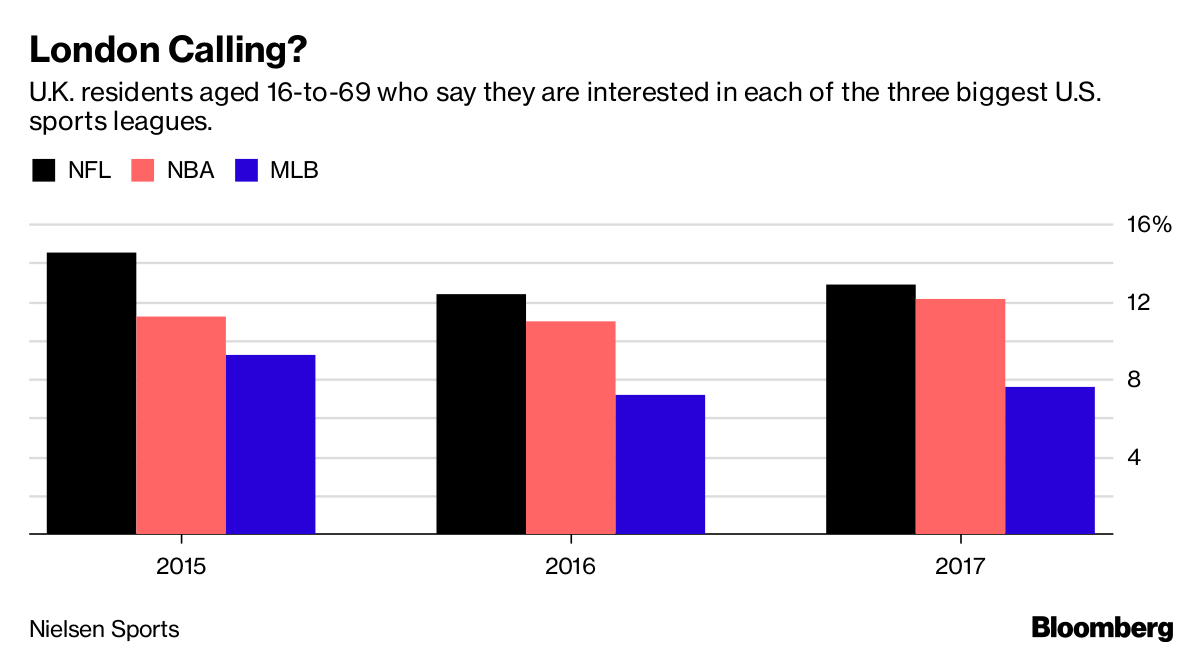
Jon Stainer, managing director for the Americas at Nielsen Sports, said the modest numbers are a good sign: “It shows that they can sustain interest.”
For the NFL to be leading the way is a triumph of sorts. American football, as a sport, has almost zero native presence in Britain. Nielsen doesn’t bother to ask about interest in the generic game. In last year’s survey, 20 percent of those polled said they are interested in basketball as a sport—and 15.6 percent, in baseball.
Stainer attributed the NFL’s success to its sustained presence, its commitment to playing in London and its broadcast strategy—including a weekly NFL highlights show that airs on the BBC immediately after Sunday’s Premier League match of the day. Live games on pay TV don’t hurt, either.
Both the NFL and NBA, said Stainer, have done a good job of importing not just their games but the atmosphere surrounding them. “It’s a different sports experience. It’s a lot more social,” he said. “There is a lot more celebration. It draws in big crowds who are not just there for the sport.”
But these annual sports roadshows aren’t enough to create lifelong fans, said Simon Chadwick, professor of sports enterprise at the University of Salford in Manchester. “Britain has an undiminished appetite for sport, and people here are prepared to spend to consume it,” said Chadwick. “However, it will take more than a couple of games at a swanky venue in London to persuade large numbers of people that baseball is the sport for them.”
If baseball—and basketball and football, for that matter—want real fans, Chadwick said, they should invest more heavily in teaching kids to play the games.