 US Market

Stock Activity:
ALL USD Stocks

Chat Now !

Congress Finds Itself a Bystander in Trump’s Decision on Striking Syria
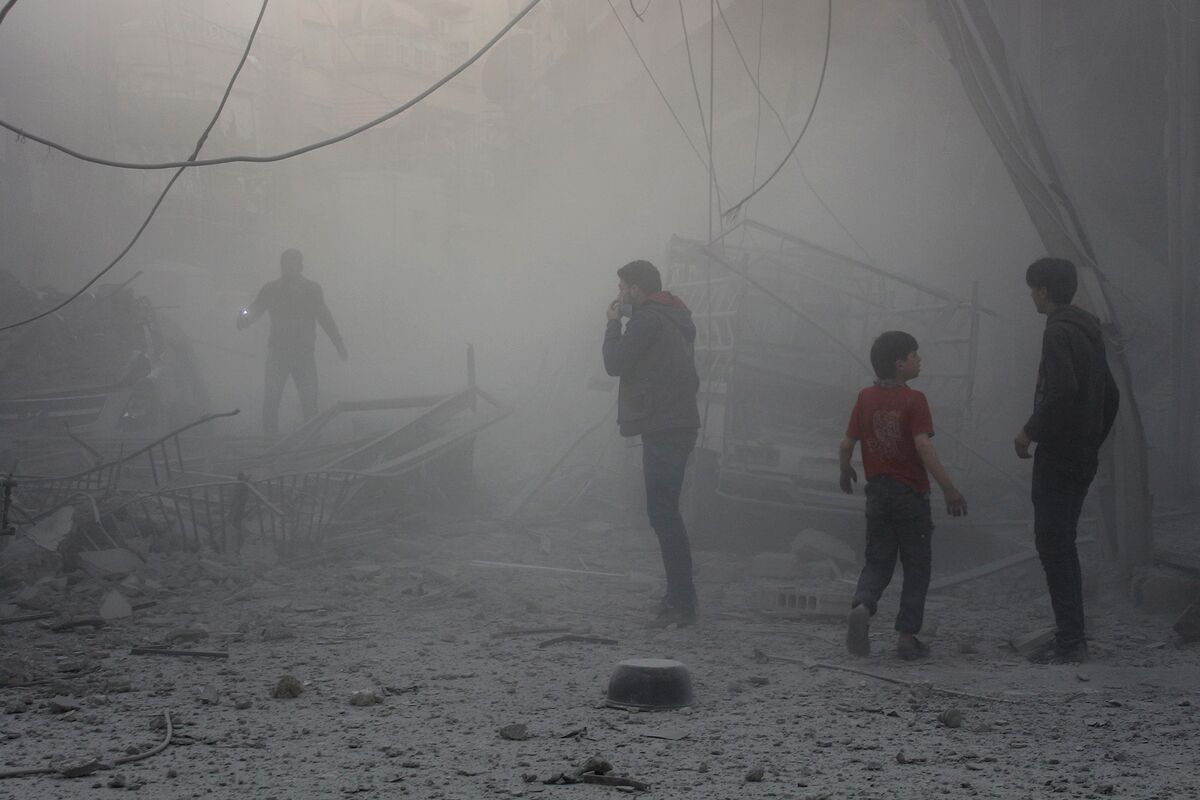
The U.S. Congress will play a clear role if President Donald Trump decides to strike Syria for using chemical weapons: bystander.
The U.S. Congress will play a clear role if President Donald Trump decides to strike Syria for using chemical weapons: bystander.
While Defense Secretary Jim Mattis has promised lawmakers that a small group of congressional leaders will be given a confidential heads-up before any missiles fly, few lawmakers expect Trump to wait for them to approve a one-off military move against President Bashar al-Assad’s regime.
But the possibility that the U.S. may become more deeply engaged in Syria’s seven-year civil war is reviving a long-standing malaise in Congress that three successive presidents have relied on a 2001 congressional authorization that was aimed at al-Qaeda after the Sept. 11 attacks.
“The president currently does not have any legal authority to wage war against nation-states -- missile strikes against Syria, for example -- without coming to Congress,” Democratic Senator Tim Kaine of Virginia, a member of the Senate Foreign Relations Committee who has long pressed for an updated Authorization for Use of Military Force, said Thursday on MSNBC. “That 2001 authorization is a complete blank check to the president, and it’s long past time that we impose some reasonable limitations.”
A QuickTake: Why Assad’s Victories Leave Him Ruling Ruins in Syria
Kaine said he and the committee’s chairman, Republican Senator Bob Corker of Tennessee, are working to draft a proposal that would put “more constraints on the when, where and who we are fighting against.”
The last such effort, in 2015, stalled in Corker’s committee as Republicans sought a broad and open-ended authorization to prod Democratic President Barack Obama into more aggressive military operations against terrorists in many locations. Democratic lawmakers wanted to limit the geographic reach and duration of any measure.
Corker said there’s no guarantee the latest effort to update the war authorization will be any easier than the last one.
“The first step is to get it out of committee, which is going to be a heavy effort,” he said. “The administration is not particularly interested in it.”
In testimony on Thursday before the House Armed Services Committee, Mattis said the U.S. had “the authority to deal with” Syria’s alleged use of chemical weapons against civilians to “stop the murder of innocent people.”
Troop Defense
He also argued that a strike would -- at least theoretically -- be in defense of the 2,000 U.S. troops that are in Syria with a mission to defeat what remains of Islamic State.
“The use of chemical weapons in Syria is not something that we should assume, ‘Well, because he didn’t use them on us this time, he wouldn’t use them on us next time," he said of Assad.
The Pentagon chief said any new resolution should take into account the fluid nature of terrorist organizations, that they could move across borders with impunity and that changing some legal justifications could expose the government to risk.
“I can show you where al-Qaeda becomes al- Qaeda in Iraq, that becomes ISIS, I can show a continued thread all the way through,” he said, using an acronym for Islamic State.
Representative Tulsi Gabbard of Hawaii is among Democrats who argue that’s become an excuse for presidents to assume they have a blank check for military action.
“Article I of the Constitution gives Congress the sole power to declare war,” she told Mattis. “Congress has not done so against the Syrian government.”
— With assistance by Laura Litvan, and Steven T. Dennis