 US Market

Stock Activity:
ALL USD Stocks

Chat Now !

Dollar's Future in Focus as Trump Lauds Greenback: Davos Update
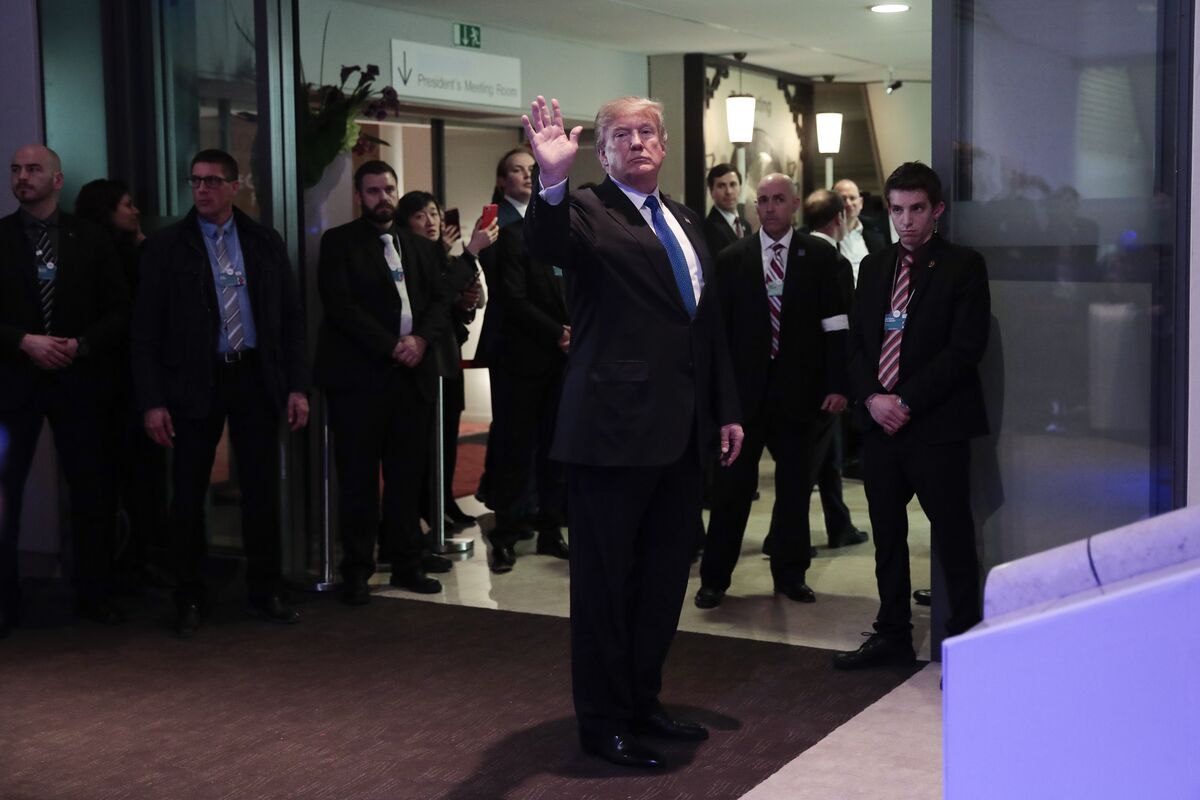
Billionaires, world leaders and investors are gathered in Davos, Switzerland, for the World Economic Forum’s annual meeting to hobnob and discuss topics ranging from the global economy and sexual harassment, to the risks and opportunities of artificial intell…
Follow our full coverage of Davos 2018 here.
Billionaires, world leaders and investors are gathered in Davos, Switzerland, for the World Economic Forum’s annual meeting to hobnob and discuss topics ranging from the global economy and sexual harassment, to the risks and opportunities of artificial intelligence. But it was U.S. President Donald Trump grabbing the most limelight.
Here are the latest developments, updated throughout the day. (Time-stamps are local time in Davos.)
Follow TOPLive’s blog on Trump’s Davos speech in real time here
Trump Holds Court (12:42 p.m.)
Reminiscent of President Donald Trump’s own Cabinet meetings, top executives from Europe’s most important companies took turns trying to impress him at a gathering in the Swiss Alps. “So are you going to be investing in the U.S.?” Trump asked Bayer AG CEO Werner Baumann as TV cameras rolled. When Baumann described a $16 billion investment near St. Louis, the president nodded his approval before turning to the next chief executive.
Dollar Will Get Stronger, Trump Says (12:27 p.m.)
Trump predicted the dollar will strengthen due to accelerating U.S. economic growth. “We are doing so well, our country is becoming so economically strong again – and strong in other ways too, by the way – that the dollar is going to get stronger and stronger,” Trump said in an interview with CNBC. There is no alternative to the dollar as a reserve currency, he added.
Action Needed on Bitcoin Risks (12:16 p.m.)
The international community needs to act to counter the risks presented by Bitcoin, according to European Central Bank Executive Board member Benoit Coeure. “I will expect for instance a G-20 discussion in Buenos Aires in March to focus very much on these issues with a regulatory answer,” Coeure said during a Bloomberg-hosted panel discussion.
Dollar’s Reserve-Currency Status Under Review (11:38 a.m.)
The dollar’s position as the world’s main reserve currency is under review, according to Ray Dalio, founder and co-chief investment officer of Bridgewater Associates LP. “I do believe currency will be a big issue this year as there’s a reconsideration of how important the dollar is,” Dalio said on a panel discussion.
Markets Testing U.S.’s Weak-Dollar Resolve (11:16 a.m.)
Markets are seeing how far the U.S. is ready to accept a weak dollar, UBS Chairman Axel Weber said on a panel. “The U.S. position has always been very outspoken to focus on the strong dollar being in the interest of the U.S. If there is some deviation from that, markets are looking at it and saying shall we test that new proposition. I think in the end the U.S. will come back to the proposition that a strong dollar is in the U.S. interest.”
Currency Volatility Unhelpful (11:09 a.m.)
The G20 group of rich nations should stick to an agreement not to target exchange rates for competitive purposes, ECB’s Coeure said. “We have seen a lot of volatility created recently by different statesmen, and I think that it’s not helpful,” Coeure said during a panel hosted by Bloomberg.
Tsinghua Tongfang Mulls Listing Units Overseas (11:08 a.m.)
Tsinghua Tongfang will create as many as three new listed companies, President Huang Yu said in an interview. Company considers listing of security equipment arm Nuctech and also environmental protection and internet units.
Europe Worried About U.S. Trade Policy (10:33 a.m.)
Europe is concerned about U.S. trade policy under President Donald Trump, according to the European Commission’s Vice President for Jobs, Growth, Investment and Competitiveness, Jyrki Katainen. “We are a bit worried about the development in the U.S. because we want to avoid, for whatever the price, a trade war,” Katainen said in an interview with Bloomberg Television. “It’s harmful for everybody, and we do hope that President Trump would look at trade and multilateral cooperation more positively in the future.”


France Central Bank Governor Francois Villeroy de Galhau
France Takes Issue With Dollar Remarks (10:17 a.m.)
Bank of France Governor Francois Villeroy de Galhau joined a chorus of officials defending a global pledge to refrain from currency devaluations. Referring to a statement issued by members of the International Monetary Fund in October, Villeroy said in a Bloomberg Television interview: “What we all said, including the new U.S. administration, was that we will not target our exchange rates for competitive purposes. This sentence is very important. It remains the rule of the game. It’s a rule of mutual trust.”
Trump to Promote U.S. Business, Urge Joint Action (9:52 a.m.)
U.S. President Donald Trump will say there’s no better time to invest in the U.S. during his speech on Friday, according to a senior administration official. In a speech lasting about 15 minutes, Trump will urge the international community to work together to combat terrorism and thwart North Korea’s nuclear ambitions, the official said.
Trump Tariffs Open Door for EU, Danish PM Says (9:39 a.m.)

Rasmussen Says U.S. Trade Tariffs Give Opportunities for Europe
U.S. President Donald Trump’s decision to impose tariffs on selected products will ultimately create opportunities for Europe to step in and benefit from the shift in global trade dynamics, Danish Prime Minister Lars Lokke Rasmussen said. Still, the signals from Trump on trade are “not good for the world economy, honestly speaking,” he said in a Bloomberg Television interview.
Ireland Mulling Bank Stake Sales (9:16 a.m.)
Ireland is monitoring the value of the state’s banking assets as it considers possible sales, Finance Minister Paschal Donohoe said. In an interview with Bloomberg Television, Donohoe added that Ireland wants a seat on the European Central Bank’s executive board and will decide imminently if it will nominate someone to succeed Vice President Vitor Constancio.
Europe Wary of U.S. Tax Reform (8:51 a.m.)
Europe needs to carefully assess the consequences of the U.S. tax reform, Economic and Financial Affairs Commissioner Pierre Moscovici said. “We have sent letters, five ministers from the EU and the Commission to the Secretary of the Treasury and, well, they responded orally, but I think when you send a letter you need to have a response,” Moscovici said in an interview with Bloomberg Television.
Davos Takes on Sexual Harassment (8:30 a.m.)
In its own way, the #MeToo moment has come to Davos. At least two panels tackled sexual harassment head on, the first time in recent history it’s been a topic of official discussion at the World Economic Forum. The forum’s seven co-chairs this year were women, and while the attendees are still overwhelmingly male, among the younger set, half are female.
Bankers Tout Dealmaking Boom (8:29 a.m.)
A global boom in dealmaking is set to continue this year as companies use cheap funds for acquisitions and sell more shares to the public, according to top bankers at JPMorgan Chase & Co. and Deutsche Bank AG.
OECD Says Countries Showing Reform Fatigue (8:16 a.m.)
Thursday at Davos: Five Things You Need to Know
Complacency is worst enemy for economy as structural reforms are slowing down at a time they should be accelerating to take advantage of the upturn, OECD General Secretary Angel Gurria says in Bloomberg Radio interview.
Follow our full coverage of Davos 2018 here.
May Rebukes Hammond for ‘Modest’ Brexit (8:08 a.m.)
Prime Minister Theresa May’s office slapped down Philip Hammond for saying he hoped Brexit would bring only modest changes, after his comments enraged the euroskeptic lawmakers May needs to stay in her job.
UBS Staying in Post-Brexit Britain (8:04 a.m.)
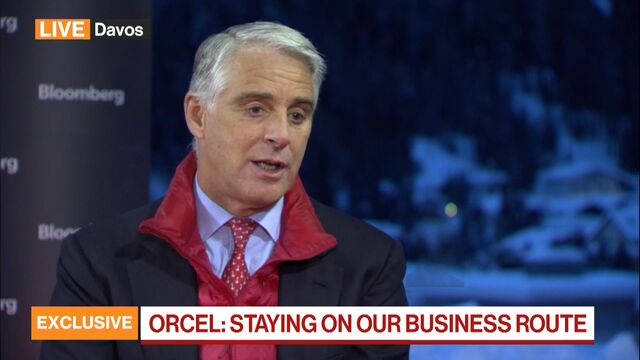
UBS Investment Bank's Orcel Says Brexit Is Still the Big Topic
Andrea Orcel, the head of UBS’s investment banking business, said the Swiss bank is seeking to keep as much business as it can in the U.K. as the nation exits the European Union. All investment banks need to take a view and start executing their plans for Brexit, Orcel said in an interview with Bloomberg Television.
Trump Apologizes for Retweets (7:55 a.m.)
President Donald Trump made a rare public apology on Friday for retweeting anti-Muslim videos posted by a British political activist two months ago, a social media misstep that hurt U.S. relations with the U.K. Retweets can “cause problems,” Trump said in an interview taped in Davos, Switzerland, with Piers Morgan of the U.K.’s ITV channel.
Collaboration Message Finds Takers (7:55 a.m.)
Cooperate, collaborate. That’s the overarching message from Davos this year for Mitsubishi Heavy Industries Ltd. Chairman Hideaki Omiya, echoing comments by Carlos Ghosn head of the Renault-Nissan auto alliance. For any one company, “it is not possible to do every single thing,” Omiya said in an interview. “It is necessary to have some collaboration.”
Trump Time (7:25 a.m.)
It’s finally time for the U.S. president to speak with his keynote address at 2 p.m. He’s expected to tell the world’s elite gathered in the resort town that his “America First” agenda will be good for the world -- not just the U.S. Last night he began making that case at a reception and dinner with business leaders. “It was very interesting and casual,” said Patrick Pouyanne, the chief executive of French oil giant Total SA. Less positive was billionaire George Soros, who wasn’t invited to meet Trump. He told an audience elsewhere in town that the president is a “danger to the world.”
Meanwhile, Big Tech struck a conciliatory note, Artificial Intelligence approached the summit of hype and bankers are still dancing.
Friday’s Highlights:
- “The End of Easy Money” panel with ECB Board Member Benoit Coeure, UBS Chairman Axel Weber and Bridgewater founder Ray Dalio, moderated by Bloomberg’s Francine Lacqua
- “Global Economic Outlook” panel with IMF Managing Director Christine Lagarde, Bank of Japan Governor Haruhiko Kuroda and Bank of England Governor Mark Carney discusses the prospects for 2018
- U.S. President Trump makes keynote speech before the close of the gathering
Here’s What Happened Thursday:
- European Central Bank President Mario Draghi attacked U.S. Treasury Secretary Steve Mnuchin’s comments on the dollar, saying he isn’t playing by the rules.
- Mnuchin sought to clarify comments he made a day earlier when he said a weak dollar is beneficial to the U.S. economy.
- Trump and British Prime Minister Theresa May reaffirmed the special relationship between the two countries.
- President Trump threatened to cut off funding to Palestinians unless they agree to resume peace talks.
- Barclays CEO Jes Staley told May to be prepared to sacrifice access to the single European market after Brexit if it means gaining control of its own financial rules, people with knowledge of the discussions said.
- Dutch Prime Minister Mark Rutte said his country will leverage its close trading partnership with China, while taking a “step-by-step” approach to Trump’s efforts to reshape the international order.
- May combined criticism with praise for technology giants as she took center stage at Davos to weigh in on the controversial debate of how to regulate them.
- Chancellor of the Exchequer Philip Hammond gave the clearest indication yet that U.K. lawmakers won’t have the full facts before them when they vote on the deal taking Britain out of the European Union.
- The heads of the world’s biggest asset manager and largest hedge fund warned against sitting on cash.
- May condemned the attitudes of men at the top of British business after revelations of a London charity dinner where hostesses were harassed and groped.
- Mining cryptocurrencies is far too energy intensive and is consuming as much electricity as a G-20 economy, Lagarde said.
- The U.S. warned Turkey to tread carefully in northwest Syria, as officials from both countries cautioned that the situation had grown dangerously combustible.
— With assistance by Andrew J Barden, and Chad Thomas