 US Market



Marriott Unveils Long-Awaited Loyalty Program to Anxious Members
Marriott International Inc. unveiled a new global loyalty program that promises richer benefits to its 110 million members and lower costs to hotel owners.
Marriott International Inc. unveiled a new global loyalty program that promises richer benefits to its 110 million members and lower costs to hotel owners.
The announcement on Monday settles questions that have been looming ever since Marriott acquired Starwood Hotels & Resorts Worldwide Inc. in September 2016. The deal created the world’s biggest hotel company, with 30 brands and more than 1.2 million rooms, and sowed fears among Starwood loyalists that corporate cost-cutters would do away with their beloved perks.
Members had “a lot of anxiety around what’s going to happen when you merge the programs,” David Flueck, Marriott’s senior vice president in charge of loyalty, said in an interview. “What will be welcome news, and almost surprising, is that we didn’t use this as a time to make the programs less rich -- we’re actually investing more in our members.”
More than half of Marriott’s room revenue comes from loyalty members, most of whom book stays directly instead of through online travel agencies such as Expedia and Priceline. On a recent earnings call, Marriott Chief Executive Officer Arne Sorenson called the loyalty program “the name of the game for the future.”
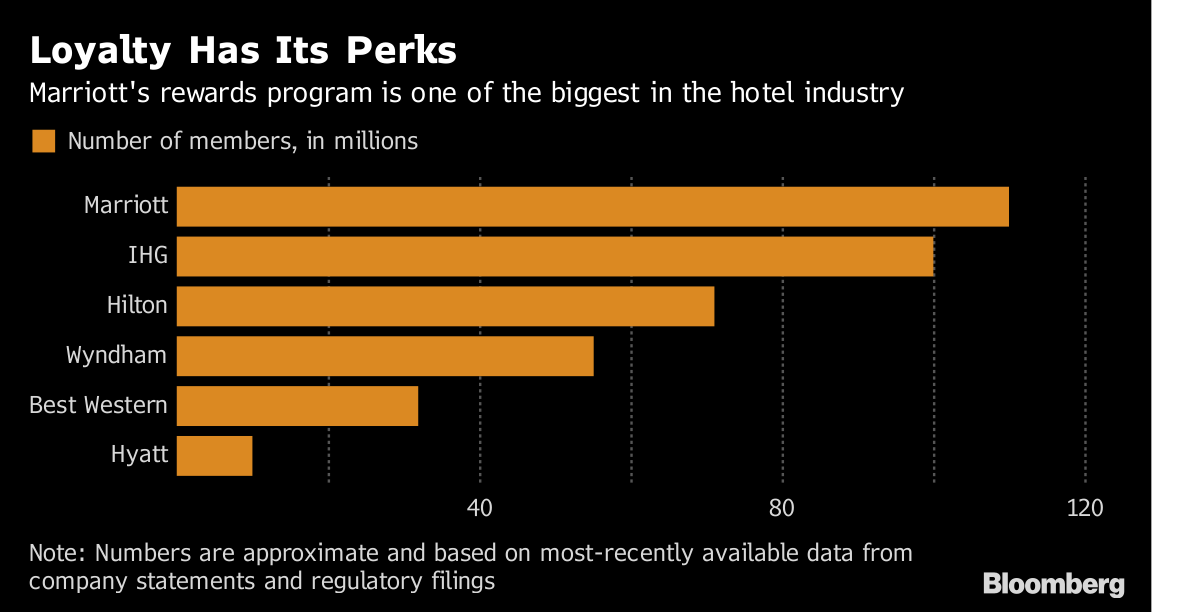
Loyalty Has Its Perks
Marriott's rewards program is one of the biggest in the hotel industry
Note: Numbers are approximate and based on most-recently available data from company statements and regulatory filings
Marriott left many favored perks intact, allowing customers to keep their lifetime status earned under the old programs and increasing the rate at which they earn points through hotel stays. On average, members will earn 20 percent more points for every dollar spent, according to Flueck.
The changes take effect in August. Highlights include:
- A common points currency that allows customers who had been members of either program to earn and redeem points at properties under 29 brands.
- Expansion of an initiative, called Marriott Moments, that lets members pay for concert tickets, sporting events and other curated experiences with credit cards or loyalty points.
- Status earned based on room nights only, eliminating the Starwood option for number of stays.
- Highest level of status requires $20,000 in annual spending.
- Room upgrades start at 25 nights booked in a year, suite upgrades at 50 nights.
- Checkouts at 4 p.m. for guests with 50-plus nights.
- New co-branded credit cards with American Express Co. and JPMorgan Chase & Co. that give holders the equivalent of 15 nights annually toward membership status.
Hotel owners pay Marriott for points awarded through stays, so increasing member benefits theoretically could raise their expenses. Flueck said the company reduced the cost to landlords by 15 percent, sharing proceeds from the newly negotiated credit-card deals with the banks.
Higher Hurdles
Some of the program’s features either haven’t been announced or won’t roll out until next year, including a plan to charge more points for free nights during peak travel seasons. Marriott has yet to say what the new program will be called.
Anxious Starwood Preferred Guest members will find things to complain about. Obtaining the highest tier of benefits is tougher, for one thing, requiring at least 100 nights and at least $20,000 spent at Marriott properties within a year. But the result “is the best possible program that anyone could have reasonably expected,” said Gary Leff, author of the travel-industry blog View from the Wing.
It would also buck a trend in the lodging business. Historically, smaller companies -- like Starwood -- have lavished frequent travelers with rich rewards to convince them to go out of their way to stay in the company’s properties. Bigger players like Marriott didn’t need to provide the same level of perks, since the company could fill rooms simply by having hotels in places where travelers needed them.
“Starwood was strong on the elite side, Marriott was stronger on earning and redemption,” Leff said. “They have basically stapled the Starwood elite program onto a version of Marriott’s earn-and-burn proposition.”