 US Market
Stock Activity:
ALL USD Stocks

Chat Now !

Mexico Might Elect Its Own Populist to Take On Trump
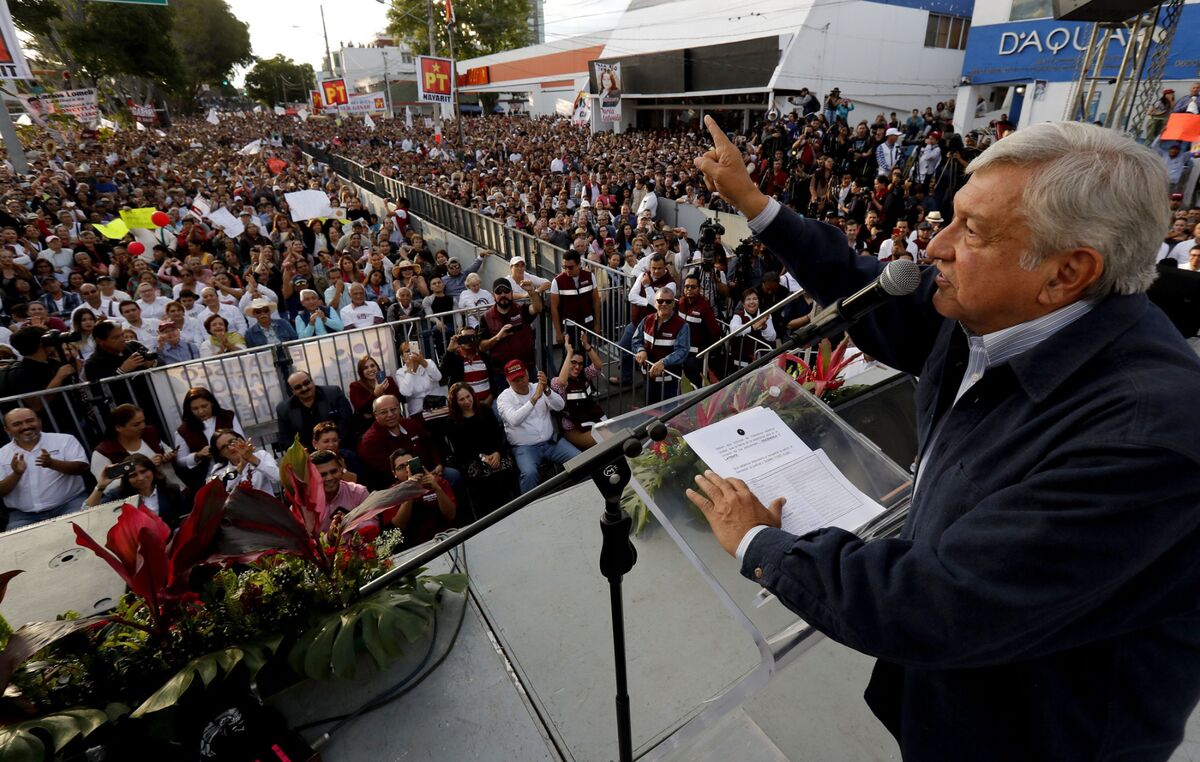
Mexico’s presidential election is less than five months away, and front-runner Andres Manuel Lopez Obrador is getting all of the attention. The leftist has an average lead of about 8.8 percentage points, according to Bloomberg’s poll tracker. He’s promising t…
Mexico’s presidential election is less than five months away, and front-runner Andres Manuel Lopez Obrador is getting all of the attention. The leftist has an average lead of about 8.8 percentage points, according to Bloomberg’s poll tracker. He’s promising to reduce poverty and end corruption and says he’ll take on U.S. President Donald Trump. While voters like his anti-establishment message, investors fear he’ll end market-friendly policies.
1. How did Lopez Obrador get to this point?
He’s a 64-year-old former mayor of Mexico City who’s run for president twice before. Widely known by his initials, AMLO, he started his political career as a member of the ruling Institutional Revolutionary Party, or PRI, and became its representative in his home state of Tabasco in 1983. Representing the left-leaning Party of the Democratic Revolution, or PRD, he won the race to be Mexico City’s mayor in 2000. He gained popularity with programs that included monthly pensions for the elderly. After losing presidential bids as the PRD candidate in 2006 and 2012, he formed the National Regeneration Movement (Morena) party in 2014. Since then, he’s toured every municipality in the country ahead of the 2018 presidential race.
2. What’s he promising to do?
He vows to root out corruption by overhauling Mexico’s system of government contracts and to slash salaries of top officials. He’d use money saved from both measures to fund public-works and social-welfare programs, although he hasn’t said how he’d pay for this before the savings were realized. In his 400-page platform, Lopez Obrador lays out a detailed plan to revitalize farms of the rural poor and to boost industries, including through government procurement programs that favor national content -- a measure reminiscent of Trump’s America First policies. He’d also shift focus from a war on drugs to poverty-fighting measures to bring down violence, including offering salaries for unemployed youth, even as he’s pledged austerity.
3. What happened in his first two presidential runs?
In 2006, Lopez Obrador led in early polls only to lose by less than one percentage point to National Action Party candidate Felipe Calderon amid a campaign blitz likening him to Hugo Chavez, the populist president of Venezuela who nationalized companies, expanded social spending and steered his country into authoritarianism. Lopez Obrador claimed voter fraud and his supporters took to the streets, blockading Mexico City’s biggest business boulevard for weeks and declaring him the legitimate president. After his second loss in 2012, to Enrique Pena Nieto, he again disputed the results, this time in court. The next year he led protests against foreign investments in Mexico’s state-owned energy company, but a heart attack cut his flag-waving short.
4. Why is he leading in the polls now?
After 12 years of soaring violence, stagnant salaries and rampant corruption, his supporters are willing to look the other way from some of his more questionable proposals in order to kick out the ruling PRI party. At least eight former governors from the PRI party have been arrested or are being investigated on corruption allegations during the administration of Pena Nieto; the president himself and some top associates came under fire for obtaining homes from government contractors. Voters have also grown numb to officials comparing Lopez Obrador to Chavez, since, courtesy of Trump, some of the threatened doomsday scenarios have already come true: the peso has plunged and foreign investors have shut down plants amid Trump’s threats to end Nafta.
Bloomberg Poll Tracker
Mexico election
Data: Polls compiled by Bloomberg; graphic by Bloomberg QuickTake

5. What might this mean for investors?
Lopez Obrador has been vague about what he’ll do to landmark legislation that opened the energy sector to private investment. Two years ago he said he’d cancel the reform; last year he said he’d hold a public consultation to decide the issue. Recently some of his choices for cabinet members say he won’t do that either, nor would he cancel oil contracts that were already awarded. Until he says so himself, investors won’t be satisfied, especially as some on his team still bash the energy reform. On Feb. 1, Lopez Obrador reiterated he’d review the oil contracts. His platform also proposes halting private partnerships with state-oil company Pemex until a new system is put in place.
6. Anything else?
Lopez Obrador has said that if he becomes president he’ll seek to dismantle the capital’s $13 billion new airport project, which is already underway. He argues it’s being built on sinking land that is inflating an already overpriced venture. Investors say it would cost the country billions in wasted labor and materials, kill fees and debt restructuring. Lopez Obrador insists he could build the airport on the cheap elsewhere without canceling contracts, but some engineers question the viability of his alternative site. It’s that stubbornness that worries the market.
7. What would he do about Nafta?
He’s said that Pena Nieto has been too soft on Trump and that he can’t wait to sit at the table to rework the North American Free Trade Agreement on his own terms. If a deal is reached now that doesn’t benefit Mexico, he warns, he’ll redo it as president. At the same time, his pick for Nafta negotiator says she wouldn’t seek to start the work all over again to modernize it. Lopez Obrador’s platform doesn’t differ too greatly from Pena Nieto’s on trade, although he’s criticized Nafta for displacing small farms and would demand mutual respect between the two countries. While much of the differences may come down to rhetoric, if he plays verbal hardball, it may not go well for negotiations as sensitive as Nafta’s. He’s also pledged to have Mexico become self-sufficient in food, though he hasn’t explained how he’d do that within a free-trade framework.
8. What’s he doing to win over skeptics?
He’s tried to soften his image by reaching out to businessmen, some of whom he’d previously labeled part of the “mafia of power.” He’s also promising not to specifically target Pena Nieto and his administration in anti-corruption efforts, which may backfire for some diehard anti-PRI voters. He’s even floated the possibility of amnesty for drug cartel leaders, although he later said it would only apply to shortening prison sentences, and only if victims of violence agree to it. That, along with his rejection of Mexico’s current drug war policy, may appeal to Mexicans tired of record levels of bloodshed. But it leaves security cooperation with the U.S. in doubt, especially since the Trump administration has made border security a top priority.
9. What are the odds that he’ll win?
With many candidates competing for the presidency, including independents for the first time, he may need less than a third of registered voters to win. Polls have placed him solidly in the lead, surprising experts who had expected the gap to narrow once parties picked their contenders. Instead, Ricardo Anaya, the PAN party candidate is barely keeping up in second place, while Jose Antonio Meade of the ruling PRI party is in a distant third place. That’s not stopping several business leaders from forecasting a Meade victory. After all, Lopez Obrador also led by wide margins in February 2006, only to lose ground after the Chavez comparisons and his refusal to participate in a debate. But that was well before a spike in corruption scandals, and violence, and Trump.
The Reference Shelf
- The Morena Party website has a biography of Andres Manuel Lopez Obrador.
- Bloomberg news on why the presidential election could be really dirty.
- Bloomberg QuickTakes on Mexico and why it might not be easy for Trump to walk away from Nafta.