 US Market

Stock Activity:
ALL USD Stocks

Chat Now !

Riptide Lashes U.S. Stock Futures as Europe Rises: Markets Wrap
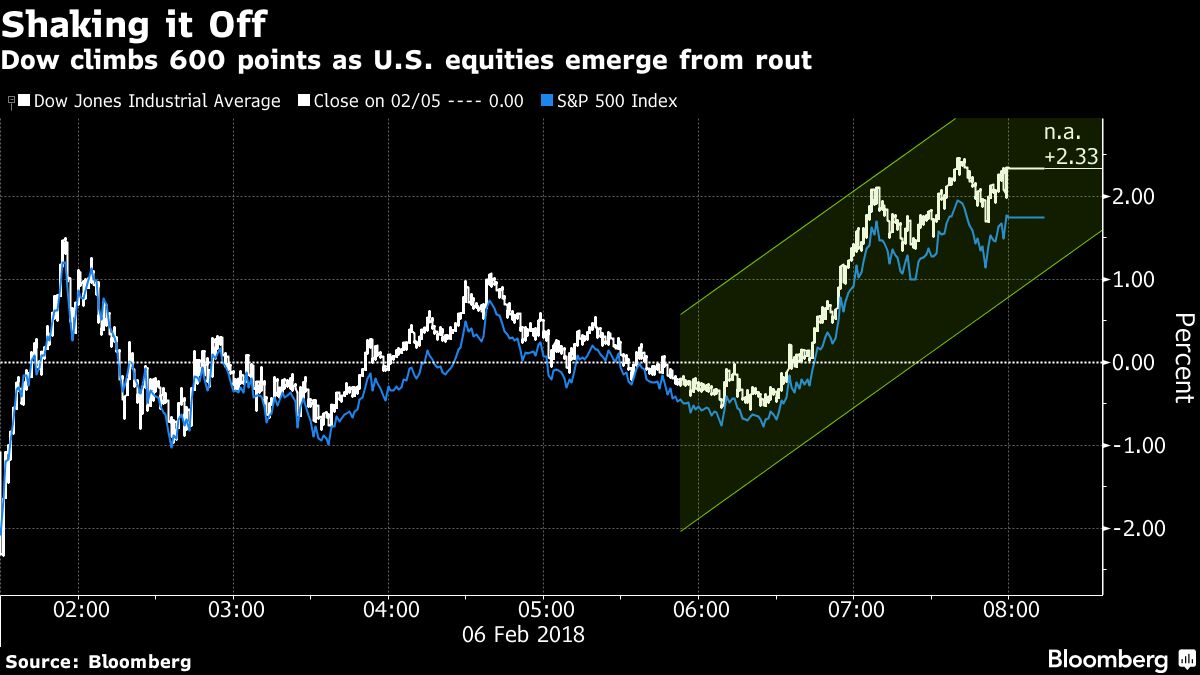
The U.S. stock market remained fragile, with futures swinging violently and volatility measures double levels from last week as investors come to grips with strong economic growth that may accelerate the removal of monetary stimulus.
The U.S. stock market remained fragile, with futures swinging violently and volatility measures double levels from last week as investors come to grips with strong economic growth that may accelerate the removal of monetary stimulus.
Traders hoping for stability instead saw futures on the Dow Jones Industrial Average swing in a 360-point range, while the March contract on the S&P 500 was down 0.5 percent after earlier falling as much as 1.25 percent. The Cboe Volatility Index held near 30. Treasuries rose, pinning the 10-year yield below 2.80 percent, while the dollar advanced.
A lingering issue for bulls is the wisdom of doing what they always do -- buy the dip -- when more selling by speculators may be imminent after Monday’s break in volatility markets. Accounts of losses and liquidations at hedge funds specializing in the asset class were rife Wednesday morning even as Wall Street strategists urged investors to consider the market’s solid underpinning in economic growth and earnings.
The S&P 500 is coming off its best day in 15 months, as buyers pored over the wreckage from Monday’s 4.1 percent rout. European equities halted a seven-day slide to join the rebound, rising the most in six weeks. Asia’s bid for a recovery faltered late in that session, with the MSCI Asia Pacific Index almost completely erasing a gain of as much as 2.4 percent.


"Sell any rallies that you get," says strategist Ian Harnett. "The volatility genie is out of the bottle."
Markets: European Open. (Source: Bloomberg)
Here are some key events scheduled for this week:
- Monetary policy decisions are due this week in Russia, Brazil, Poland, Romania, the U.K., New Zealand, Serbia, Peru and the Philippines.
- Earnings season continues with reports from Philip Morris, Tesla, Rio Tinto, L’Oreal and Twitter.
- New York Fed President William Dudley and Dallas Fed President Robert Kaplan are among policy officials due to speak.
Terminal users can read more in our markets blog.
These are the main moves in markets:
Stocks
- Futures on the S&P 500 fell 0.4 percent at 8:42 a.m. in New York. Dow contracts slid 86 points.
- The Stoxx Europe 600 Index increased 1.1 percent, the first advance in more than a week and the largest climb in more than seven weeks.
- The MSCI Asia Pacific Index advanced 0.1 percent.
- The U.K.’s FTSE 100 Index climbed 1.1 percent, the first advance in more than a week and the biggest increase in seven months.
- The MSCI Emerging Market Index climbed 0.1 percent, the first advance in a week.
Currencies
- The Bloomberg Dollar Spot Index advanced 0.1 percent to the highest in more than two weeks.
- The euro dipped 0.2 percent to $1.2347, the weakest in more than two weeks.
- The British pound sank 0.3 percent to $1.3905, the weakest in almost three weeks.
- The Japanese yen climbed 0.2 percent to 109.35 per dollar.
- South Africa’s rand declined 0.3 percent to 11.9538 per dollar.
- The MSCI Emerging Markets Currency Index advanced 0.3 percent, the first advance in a week.
Bonds
- The yield on 10-year Treasuries fell one basis point to 2.79 percent.
- Germany’s 10-year yield increased four basis points to 0.73 percent.
- Britain’s 10-year yield climbed two basis points to 1.542 percent.
Commodities
- West Texas Intermediate crude dipped 0.5 percent to $63.06 a barrel, the lowest in more than four weeks.
- Gold advanced less than 0.05 percent to $1,324.20 an ounce.
— With assistance by Adam Haigh, and Cecile Vannucci