 US Market
Stock Activity:
ALL USD Stocks

Chat Now !

They Once Saved Amazon. Now Convertible Bonds Expose Tech Qualms
They may have saved Amazon.com Inc. from the dot-com bust, but for many young tech firms convertible bonds could turn into more of a headache than helping hand.
They may have saved Amazon.com Inc. from the dot-com bust, but for many young tech firms convertible bonds could turn into more of a headache than helping hand.
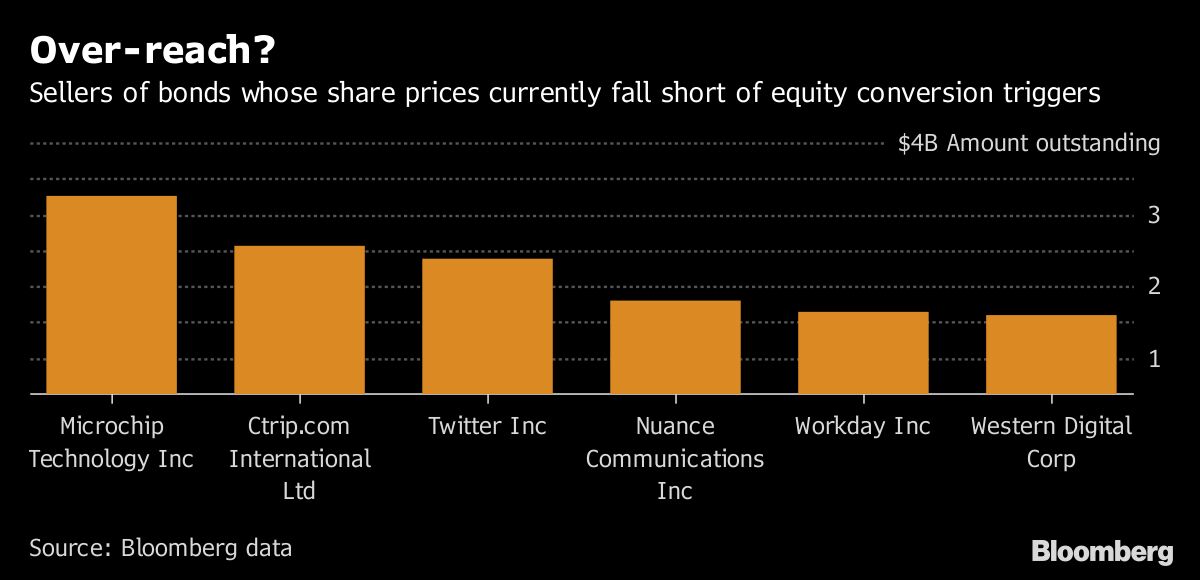
Twitter Inc. bonds are now among $30.6 billion of convertibles that are “out of the money,” meaning the stock is trading below the threshold needed to turn the debt securities into equity, according to data compiled by Bloomberg. As the rally that pushed U.S. technology heavyweights to the sky shows cracks, the possibility of further declines could force even more convertibles into the out-of-the-money club.
For firms that relied on cheap funding to fuel growth, that’s a problem. If a company’s shares haven’t hit their conversion price when the bonds come due, investors have to rely on the company to repay the outstanding debt at a potentially inconvenient time -- when growth may have stalled and resources to repay debtholders are thin.
Over-reach?
Sellers of bonds whose share prices currently fall short of equity conversion triggers
Source: Bloomberg data

“Technology companies can survive for years funding growth plans with hope, meaning equity, and if they can get it, cheap debt,” said Geof Marshall, a money manager who oversees $40 billion of assets at CI Investments’ Signature Global Asset Management in Toronto. “By the time that debt comes due the growth needs to be realized and the cash flow coming in.”
Some of the high-flying names that have relied on convertible-debt financing in recent years include Uber Technologies Inc., Twitter and Tesla Inc. Of the $65 billion of outstanding convertible bonds issued by technology firms, nearly half were out of the money as of March 29, data compiled by Bloomberg show.
To be sure, convertible bonds have rewarded investors recently: the Bloomberg Barclays U.S. Convertibles Composite Total Return Index has gained 1.5 percent this year compared with a 2.6 percent decline for the corporate counterpart. In fact, convertibles have outperformed plain-vanilla company bonds every quarter since the first three months of 2016.
And in many cases, the maturity dates for these bonds remain several years out, meaning the stocks have time to recover and reach their conversion price. The technology sector has seen hiccups before -- shares fell more than 5 percent in April 2016, only to rebound the following month. They have yet to recover their 8 percent loss in the first half of February, however.
Next Amazon
Issuing convertible debt turned out well for Amazon and its investors as the company burned cash in its early days that it harnessed into growth and investor returns.
In his 2013 biography of Amazon founder Jeff Bezos, Bloomberg Businessweek’s Brad Stone wrote that while many companies were caught off guard by the bust, Amazon could draw on a cushion of cash it had raised from convertible bonds and that probably kept it from insolvency.
The question is whether other companies will be able to match Amazon’s level of success.
Electric car-maker Tesla is burning cash and faces repayment on $3.7 billion of debt by the end of 2020, much of it convertible bonds including those it inherited from SolarCity Corp. Almost half of it is out of the money, and refinancing may be harder after a downgrade by Moody’s Investors Service to Caa1.
One of Tesla’s 2014 issues carries a conversion price of $359.87. While the shares spent a good chunk of last year trading above that level, the likelihood of conversion has tumbled in the past two weeks, as the stock lost 21 percent to close at $257.78 on Wednesday.
The possibility that these firms could be saddled with principal repayments at maturity if the bonds don’t convert is reason for worry, according to Noel Hebert, an analyst at Bloomberg Intelligence.
“For some companies it could be a cash call when they don’t need it,” leaving them with few palatable options, he said. “They either have to raise higher-cost debt, issue shares or deplete the cash coffers.”