 US Market

Stock Activity:
ALL USD Stocks

Chat Now !

Traders Question Whether the Bond Selloff Is Really Armageddon
Bond traders want to know: Is this really what Armageddon looks like?
Bond traders want to know: Is this really what Armageddon looks like?
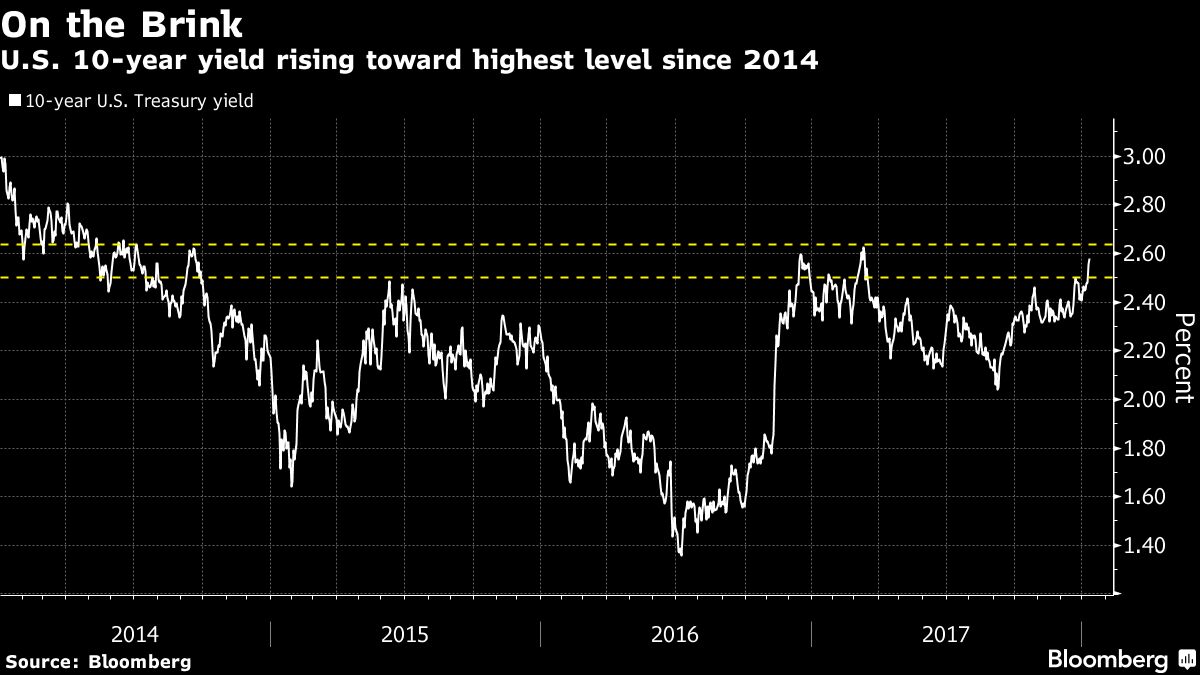
Ten-year U.S. yields are flirting with the highest levels since 2014 as longtime pillars of support for the world’s biggest bond market are eroding. Global central banks are gradually pulling back stimulus and senior government officials in China have recommended that America’s biggest foreign creditor slow or halt purchases of Treasuries. What’s more, the Federal Reserve plans to keep hiking rates with a growing economy near full employment.
And yet, even Bill Gross, the Janus Henderson Group fund manager who called the start of a bear market this week, is skeptical of how much damage can be done. He said Wednesday that he doesn’t foresee dramatic losses. In fact, he expects the 10-year yield may only rise 10 to 20 basis points more by year-end, from just shy of 2.6 percent now.
“The bear market that I’m talking about is a mild one,” Gross said in a Bloomberg Radio interview. “I don’t think we’re headed for investment Armageddon.”
Trading after the China news shows investors aren’t exactly storming the exits. Since 6 a.m. in New York on Wednesday, the 10-year yield has kept to a 2.2 basis point range. That may signal support for the Treasury’s $20 billion auction of the maturity at 1 p.m.
Foundation Intact
And therein lies the rub about calling for doomsday in this market: History has proven time and again that yields rise and fall in fits and starts. It takes a dramatic change in the fundamental outlook for U.S. fiscal and monetary policy (think Donald Trump’s election victory most recently) or turmoil in riskier assets to really jolt bonds one way or the other.
And while 2018 has brought some telegraphed risks into sharper focus, nothing has rocked the foundation of the $14.5 trillion Treasuries market, said Aaron Kohli, an interest-rate strategist at BMO Capital Markets in New York.
To Kohli and John Briggs at NatWest Markets, the latest runup in yields was magnified because the market was caught offside, going all-in on the flattening yield-curve trade that dominated the end of 2017. With the smallest spread between short- and long-term debt in a decade, it was “vulnerable to a correction,” Briggs said.
Positioning data suggest that speculators who were late getting into the flattening wager got burned. Hedge funds and other large speculators had built up their largest net-long position in Treasury bond futures in 13 years as of mid-December, and mostly held their ground in the ensuing weeks.
“A lot of the speculative accounts started to pile into the flattening trade -- there was this bandwagon effect,” Kohli said. On the other hand, “if you were sitting in the flattener for a year, you’ve done really well. Why not take a little profit?”
And for all the angst about the latest selloff, buyers may still be waiting to pounce, even if China is taking a breather.
BMO suggests buying 10-year Treasuries if yields climb to 2.6 percent. And Dan Ivascyn, group chief investment officer at Pimco, said the firm would consider adding Treasuries on further bond-market weakness, according to a tweet from Reuters.