 US Market

Stock Activity:
ALL USD Stocks

Chat Now !

Trump and Republicans Risk Taking Blame for ‘Schumer Shutdown’
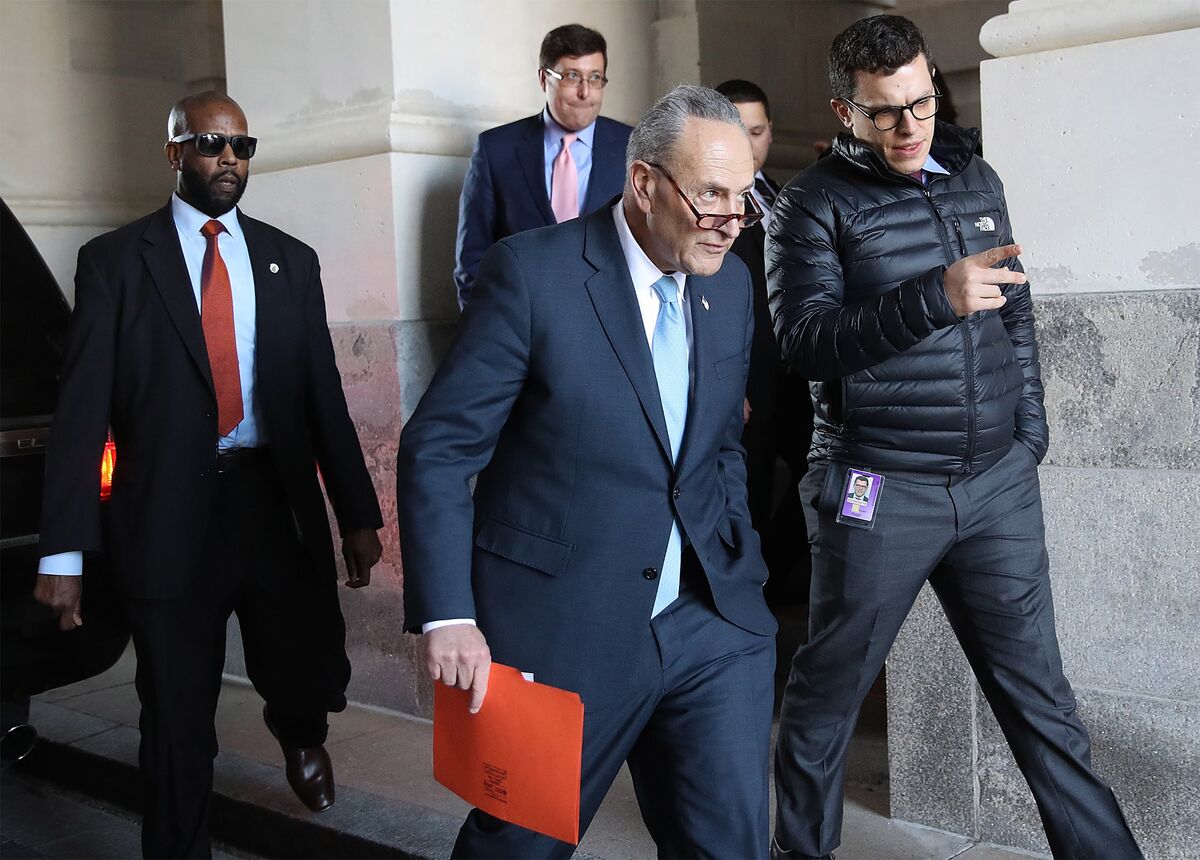
Already at least one early poll suggests that Republicans and Donald Trump, as chief executive, would carry more of the blame than Democrats.
Republicans spent Friday trying to hang the blame for a possible government closure on the Senate’s top Democrat, saying the “Schumer Shutdown” meant the party was putting the needs of immigrants ahead of the country.
But many Americans think someone besides Senator Chuck Schumer bears responsibility -- his fellow New Yorker, President Donald Trump. And already at least one early poll suggests that Republicans and Trump, as chief executive, would carry more of the blame than Democrats.
About 48 percent of Americans would blame the president and his party, which control the White House and both houses of Congress. Twenty-eight percent say the Democrats would be at fault, according to a ABC News/Washington Post poll released Friday.
The symbolism is particularly rich for Trump, who would see the government shut down on the one-year anniversary of his inauguration, after a campaign in which he pledged to shake up a capital that he said had lost its way.
He is in a unique position to change that, with his Republican party controlling all of Washington for the first time in more than a decade. Shortly after his aides launched a barrage of attacks against Schumer at a White House briefing, Trump invited the Democratic leader over for a midday Friday one-on-one meeting to discuss a resolution of the standoff.
Schumer spent about an hour and a half at the White House. “We made some progress but we still have a good number of disagreements,” he told reporters at the Capitol.
A White House official said no deal was made. The person asked not to be identified discussing a private meeting.
Trump’s Inconsistency
Trump, for his part, said Democrats were looking to distract from the economic success he attributes to the successful passage of legislation overhauling the tax code.
“I really believe the Democrats want a shutdown to get off the subject of the tax cuts because they’ve worked so well,” Trump told reporters Thursday in Pittsburgh.
More: Your Questions Answered on Government Shutdown: Quicktake Q&A
But Republican squabbling and Trump’s own penchant for tweets and remarks that throw negotiations into disarray are proving a formidable obstacle. In just the last week, he infuriated Democrats by denigrating immigrants from Haiti and African countries in a private meeting, then seemed to reject a child-health provision Republicans included in a spending bill specifically to entice Democratic votes. His staff walked back the tweet on the health-care provision.
In December, he tweeted that he didn’t see a deal being possible with Democrats and accused Schumer and House Minority Leader Nancy Pelosi of desiring “illegal immigrants flooding into our Country unchecked.” That led the two leaders to cancel a meeting with the president.
Trump was also blamed by lawmakers in both parties for scuttling a bipartisan deal on immigration earlier this month that may have defused Friday’s budget standoff altogether.
The drama may simply feed public disgust with Washington. In the ABC News/Washington Post poll, 18 percent say both sides share the blame in equal measure. The poll was conducted Monday through Thursday, before House Republicans passed stopgap legislation that would fund the government for another 30 days. GOP leaders hope that will help them deflect some of the blame onto the opposition party.
But Schumer’s caucus are not the only lawmakers in the Senate refusing to go along with the House Republicans’ plan. Republican senators Lindsey Graham and Rand Paul have said they would vote against the House bill, and John McCain is home in Arizona battling cancer.
Even some conservative House Republicans expressed doubt that their party would be able to pin blame for a shutdown on Democrats.
‘It’s hard to do that, when as I understand it, there are three Republicans voting no in the Senate,” said Representative Scott Perry, a Pennsylvania Republican.
Image Problem
Furloughing federal workers would only contribute to the sense that Trump is unable or unwilling to govern -- a notion that his critics say was underscored by the president’s rash tweeting and his rejection of the bipartisan immigration deal. In an acknowledgement of the image problem, the White House said parks and monuments would stay open, at least for some time, in the event of a shutdown.
Moreover, the economic impact of an extended shutdown could dampen the booming economy that’s provided one of the few bright spots for Republicans during Trump’s tumultuous first year. A shutdown that lasts a week and puts 850,000 federal workers on furlough would reduce U.S. economic growth in the quarter by around 0.1 percentage point, according to Nancy Vanden Houten of Oxford Economics.
The stakes, for both sides, include the outcome of November’s midterm elections -- and, in turn, the success of the Trump presidency.
At the White House, officials said Democrats had “weaponized” the federal budget and abdicated their constitutional responsibility, arguing chiefly that men and women in the military and protecting the border would be forced to serve without pay. After previous shutdowns, Congress has always paid back wages to federal workers whether or not they were furloughed.
White House officials argued that Democrats have supported short-term funding bills like the House legislation in the past. Schumer and his colleagues are “hellbent on a shutdown,” Legislative Director Marc Short said.
2013 Shutdown
But such arguments were deployed in the last shutdown -- and Democrats aren’t persuaded they result in political punishment.
In 2013, congressional Republicans forced a government shutdown in a bid to defund the Affordable Care Act. While former President Barack Obama railed against the impact on federal workers, Republicans went on to flip nine Senate seats and 13 House seats in the subsequent midterm elections.
And Democrats argue that the issue of blame is more muddled this time. If Senate Majority Leader Mitch McConnell isn’t able to deliver the full support of his caucus for a spending bill, Democrats believe they can frame Republican leaders as offering an unreasonable strategy even their own members can’t support.
It’s a gamble. The moment requires Democrats to essentially choose between two pillars of their political brand: protecting immigrants illegally brought to the U.S. as children, and the broader notion they are the responsible stewards of the federal government, willing to prioritize basic economic and political stability.
Senate Republican leaders say they’re determined to force the opposition party to vote repeatedly against reopening the government, knowing that each high-profile session could spook Democrats facing tough re-election fights this year. For McConnell, a shutdown provides a golden opportunity to paint legislators like Joe Donnelly of Indiana and Claire McCaskill of Missouri as dangerous extremists unwilling to come to the negotiating table. In total, there are 10 Democrats running for re-election this November in states that the president won in 2016.
Act of Defiance
But in the bizarre political climate surrounding Donald Trump, that could prove a positive for Democrats.
Trump is so deeply unpopular with Democrats that a shutdown may be regarded as a defiant act in line with the “resistance” movement already motivating the party’s base ahead of the November elections. In a Pew poll released this week, 83 percent of liberals described themselves as “looking forward” to the midterms, while just 61 percent of conservatives said the same.
Democrats see immigration as a particularly winning issue, and a budget battle as an ideal forum to force Republicans to publicly choose sides. In a survey conducted by Hart Research for liberal groups, 81 percent of voters in battleground states say a budget agreement should include deportation protection for immigrants brought to the country illegally as children -- the so-called “Dreamers.” A majority -- 54 percent -- say that a spending bill reflecting their priorities is more important than avoiding a shutdown.
— With assistance by Laura Litvan