 US Market

Stock Activity:
ALL USD Stocks

Chat Now !

Trump Travel Ban Gets Support From Key Justices at Supreme Court
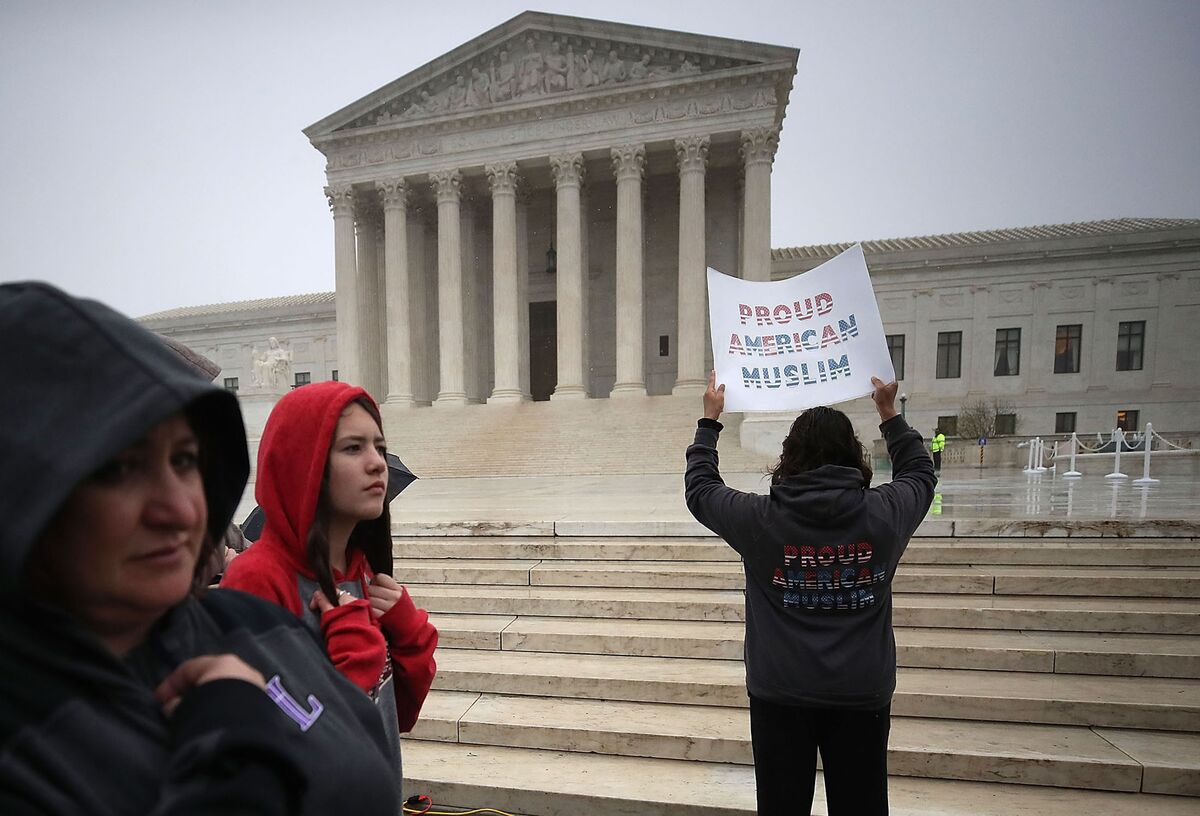
President Donald Trump’s travel ban drew support from key U.S. Supreme Court justices as the court took its first direct look at a policy that indefinitely bars more than 150 million people from entering the country.
President Donald Trump’s travel ban drew support from key U.S. Supreme Court justices as the court took its first direct look at a policy that indefinitely bars more than 150 million people from entering the country.
Hearing the last arguments of their nine-month term Wednesday, the justices considered contentions that Trump overstepped his authority and was motivated by anti-Muslim animus.
Chief Justice John Roberts and Justice Anthony Kennedy both indicated they were skeptical of arguments against the policy, including contentions that Trump was motivated by bias. Roberts suggested those arguments might prevent a president from taking the advice of his military staff to launch an air strike against Syria.
"Does that mean he can’t because you would regard that as discriminating against a majority-Muslim country?" Roberts asked.
Kennedy suggested the travel ban was more flexible than opponents contended, pointing to a provision in the most recent version requiring officials to revisit it every 180 days.
"That indicates there will be a reassessment and the president has continuing discretion," Kennedy said.
The court will rule on the third version of a ban that triggered chaos and protests at American airports when Trump signed the first executive order a week after taking office. Although two federal appeals courts have ruled against Trump, the Supreme Court let the policy take full effect in December.
The high court’s decision, likely to come in the final days of June, promises to be a major pronouncement on the president’s control over the nation’s borders, as well the court’s power to question the president’s national security decisions. It may also serve as a judgment on an unconventional presidency marked by ad-hoc policy decisions and pointed Twitter comments.
The court’s liberal justices gave the policy tougher scrutiny. Justice Sonia Sotomayor, a Democratic appointee, asked, "Where does the president get the authority" to impose the ban when Congress already enacted a visa waiver process that required heightened vetting in some cases.
Justice Elena Kagan, another Democratic appointee, raised a hypothetical issue of a president who had made anti-Semitic remarks and whose administration found security reasons to recommend a ban on travel from Israel.
"This is an out-of-the-box kind of president in my hypothetical," she said. "Who knows what his heart of hearts is."
"The question is, what are reasonable observers to think?" Kagan said.
People began lining up days in advance for one of the roughly 50 seats the court typically sets aside for members of the general public.
Underscoring the widespread interest in the case, the court will post an audio recording of the argument on its website by Wednesday afternoon. It’s the first time this term the court has released same-day audio.
The policy bars or limits entry by people from Iran, Syria, Somalia, Libya and Yemen. The ban also blocks people from North Korea and a handful of Venezuelan government officials, though those aspects of the policy aren’t at issue at the high court. Trump removed Chad from the list of restricted countries earlier this month.
The case is Trump v. Hawaii, 17-965.